


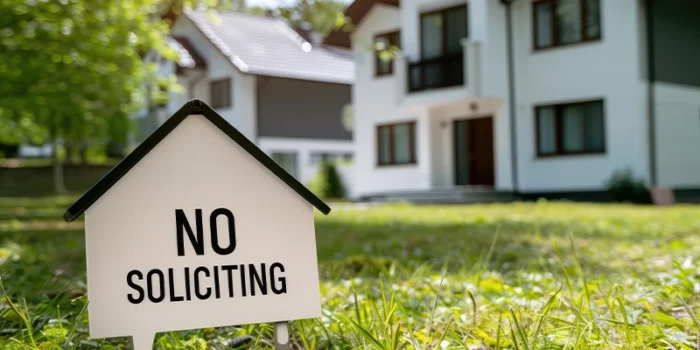
Are HOA no soliciting policies enforceable for noncommercial activities? Such activities are protected in California, but what does that entail for HOA boards?
What Counts as HOA Noncommercial Solicitation?
Noncommercial solicitation is when a person or a group of people solicits for a political, charitable, religious, or any other noncommercial agenda.
This type of solicitation doesn’t seek monetary gain or business endeavors. It may include the following activities:
- Seeking signatures for a petition
- HOA members are distributing flyers for an upcoming HOA election
- HOA members canvassing about local issues
- A group of homeowners is organizing a meeting to tackle board decisions
- Members are discussing community issues both in person and online.
California Civil Code §4515
In California, the rights of homeowners to conduct noncommercial solicitation are protected by law.
Civil Code Section 4515, formerly SB 407, provides that any governing document provision is void and unenforceable if it prohibits or unreasonably restricts members and residents from using common area to peacefully assemble and communicate with other members, relating to common interest development living (i.e., elections, legislation, election to public office, or the initiative, referendum, or recall processes), as long as such is done in a reasonable manner.
Additionally, the legislation bans HOAs from charging fees or requiring members to make deposits to use common areas (e.g., security deposits) for such activities. It also protects members’ rights to circulate information of concern in a reasonable manner.
What California HOA Boards Can’t Do?
With this new rule, HOA board members are limited by the HOA’s no soliciting policies they implement. As such, they can’t have any policies that may sound something along the lines of:
- “No political canvassing allowed.”
- “No petitions may be circulated.”
- “Homeowners are not allowed to distribute political flyers without board approval.”
- “Residents are prohibited from using the clubhouse for campaign meetings.”
- “Homeowners may not criticize the board on social media.”
Apart from this, HOA board members are also not allowed to force members to pay a fee or deposit to use common areas for noncommercial solicitation, whether as payment for use or for insurance.
What HOA Boards Can Control
Even with this ban, however, the HOA board can still impose some controls. As long as these policies are reasonable and can comply with the letter of the law, they are enforceable.
Here are noncommercial HOA no soliciting policies your association can adopt.
Assigned Times
Your HOA board can limit when canvassing and other noncommercial activities are conducted in the HOA community. The HOA may limit such activities to reasonable daytime or early-evening hours. Doing so helps limit disturbances in early morning hours and late at night.
Conduct
No matter what form of interaction, including protected activities under noncommercial solicitation, should remain civil. HOA boards can include conduct and manner rules that naturally prohibit any form of harassment or aggressive behavior in the community.
Common Area Reservation
HOA boards can’t prevent or ban the use of common amenities for noncommercial solicitation. However, they still have responsibility for these amenities. They will need to secure clubhouse facilities and meeting areas. Part of that would be requiring homeowners to reserve those amenities when they plan to use them. Although, do keep in mind that requiring payment for this is still not allowed.
Common Area Use Noncommercial Solicitation
HOA boards can also adopt a policy that would require the member using a clubhouse or common area for the purposes outlined above to reimburse the association for any and all costs incurred to clean the common area meeting space, as well as reimburse the association for any costs incurred to repair damage caused by the member, resident, or their invitees.
Noise and Safety Rules
Any form of activity can become unruly, to the point that it may endanger the well-being of people involved. Given this, HOAs should ensure that safety rules for such events remain in place. You may also include noise rules to minimize the disturbances for other residents in the community.
HOA No Soliciting for Noncommercial: How HOAs Can Comply with the Law
When creating a solicitation policy, HOA boards need to tread carefully about what they include. To create rules and regulations for your community that comply with the law, try to follow these tips.
1. Review Your Guidelines
Does your HOA have rules and guidelines that mention “no soliciting”? You should check your governing documents for points that may conflict with the law. Some of these may include rules on flyers, public gatherings, common amenity use, and even signs.
Did you find any points that could expose the HOA to legal disputes over noncommercial solicitation bans? If you did, start the proper process of amending it. If you need to, try to work with legal counsel to ensure your new guidelines are consistent with the law.
2. Enforce Rules Consistently
Your HOA still has some control over the time, manner, and conduct of noncommercial solicitation activities. However, these activities usually involve people’s advocacies and opinions. Some of those opinions may clash with your own. Even in those cases, as part of the HOA board, you have the obligation to enforce rules consistently and fairly.
3. Provide Personnel Training
Not everyone involved in running the HOA is trained or educated in the laws governing noncommercial solicitation. Many of them may not know that such activities are protected. When they don’t they may try to unknowingly try to unfairly enforce bans. They may see it as mere inconveniences and disturbances for residents. This may open the HOA up to disputes.
As such, when you have personnel helping out, it’s best to provide them with proper training. Organize workshops to educate them on key California laws, including one on noncommercial solicitation.
Balancing Rules and Rights
A person’s opinion and right to advocate for pressing, relevant issues are and should be protected. That notion also applies to the HOA. But as part of the board, you have the obligation to balance this out with the well-being of your residents. Try to create policies that protect your residents while observing others’ rights.
Optimum provides expert management services to community associations in Southern California. Call us today at (714) 508-907 or contact us online to learn more!
Related Articles:
- HOA Collections Policy: What Can And Can’t The Board Do?
- HOA Special Assessments: How And When To Levy One In California?
- Aging Condo Buildings In California: What HOA Boards Should Prioritize


